There is evidence that supports that people can be motivated by rewards, to bind this principle many health care organizations have linked burnout to financial compensation to productivity.
Strategies for sustaining innovation
The fact that mental health care staff burnout is a national epidemic and leads many organizations to believe that there is nothing they can do to address the problem. Those centers that do recognize that they control many of the factors that drive burnout are often unsure how an organizational-level intervention can combat such a complex problem. Even the dauntless institutions who recognize that they must try are frequently unsure where to begin and do not believe that the resources they have to invest are sufficient to do anything meaningful. The available evidence contradicts all of these notions. Burnout is primarily a system-level problem driven by excess job demands and inadequate resources and support not an individual problem triggered by personal limitations(Weintraub & McKee, 2019).
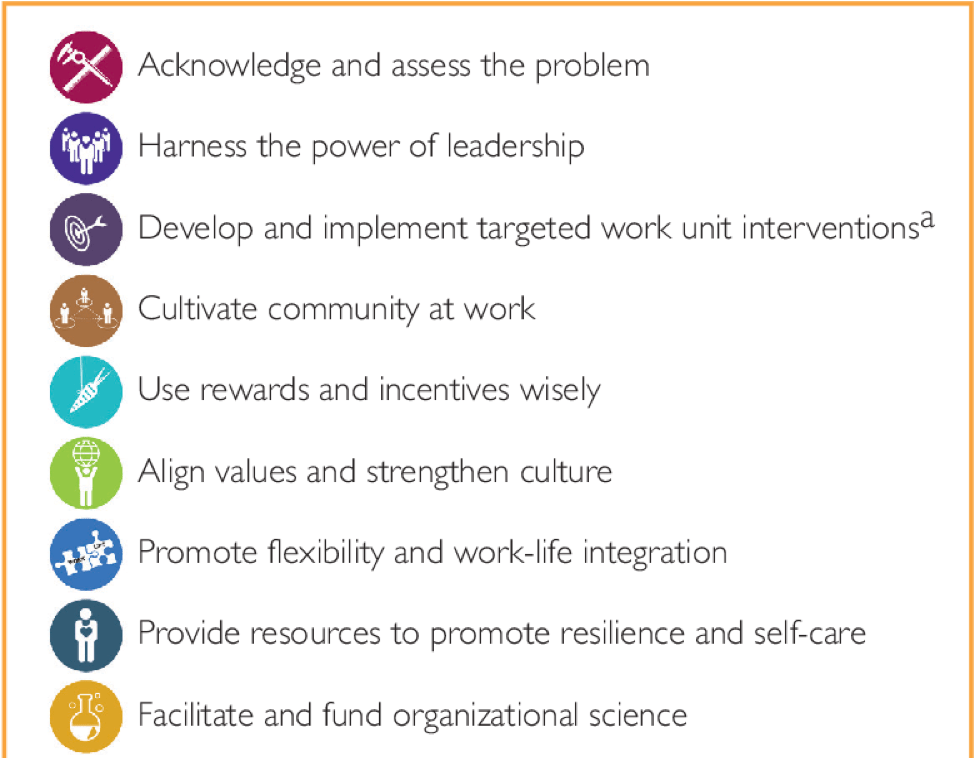
To be able to sustain organizations innovative intervention to target burnout, it is important for a strategic plan customized to the local environment along with prioritization, commitment, and follow through at the highest level of the organization. Organizations should also aspire to realize the potentially even greater benefits of taking on the challenge of improving the efficiency of their work environment, reducing clerical burden, addressing problems with workload, and having the courage to address problems with values alignment and organizational culture. Commitment from executive leadership is the prerequisite, assessment the first step, and frontline leadership a force multiplier.
Return on investment (ROI) can also be applied to determine the economic cost of burnout and guide the appropriate initial and ongoing investment to address the problem. The business case to address burnout is multifaceted and includes costs associated with turnover and lost revenue associated with decreased productivity, as well as financial risk and threats to the organization’s long-term viability due to the relationship between burnout and lower quality of care, decreased patient satisfaction, and problems with patient safety (Weintraub & McKee, 2019).
It is crucial for the organization to understand the business case to reduce burnout and promote engagement as well as overcoming the misperception that there is nothing that can be done to promote improvement in staff’s burnout. Organizations should also comprehensively examine the structure of their paid time off benefits, coverage for life events (eg, birth of a child, illness/death in family), and a strategy for coverage of nights and weekends. Compensation practices that disincentives using paid time off are shortsighted and should be eliminated.
Reference:
Weintraub, P., & McKee, M. (2019). Leadership for Innovation in Healthcare: An Exploration. International journal of health policy and management, 8(3), 138–144. https://doi.org/10.15171/ijhpm.2018.122
https://www.mayoclinicproceedings.org/article/S0025-6196(16)30625-5/pdf
 Awareness for burnout in Mental Health Care workers